AI Vor V Zakone Generator — Free Preview, Then Train Your Model
See a Free Preview in Seconds, Before You Commit
Train Your Model Once, Render Vor V Zakone in About Ten Seconds
Studio-Quality Results Without a Studio Visit
Narcis generates a free preview of your vor v zakone from one uploaded photo. The preview streams in seconds — a quick sketch, close but not you yet. If you like it, train your model once — 12 to 20 photos, we email you when it's ready — and the full pack of nine is €4,99, rendered from your model in about ten seconds a portrait. No signup before the preview, and no waiting for an email until you choose to train.
The pack is nine professional vor v zakone rendered in portrait aspect ratio (2:3) — the shape LinkedIn banners, CVs, and print profiles actually use. Each image shows varied crops, expressions, and light angles so you have real choices, not nine identical files.
Photos are processed on European servers. We use your photo to generate your headshots; we do not share it with third parties.
/vor-v-zakone · lifestyle · 3 scenes
Vor v Zakone — Russian Prison Tattoo Portraits
no account · ~15s · the first shot is free
More of the old code
one model wears them all →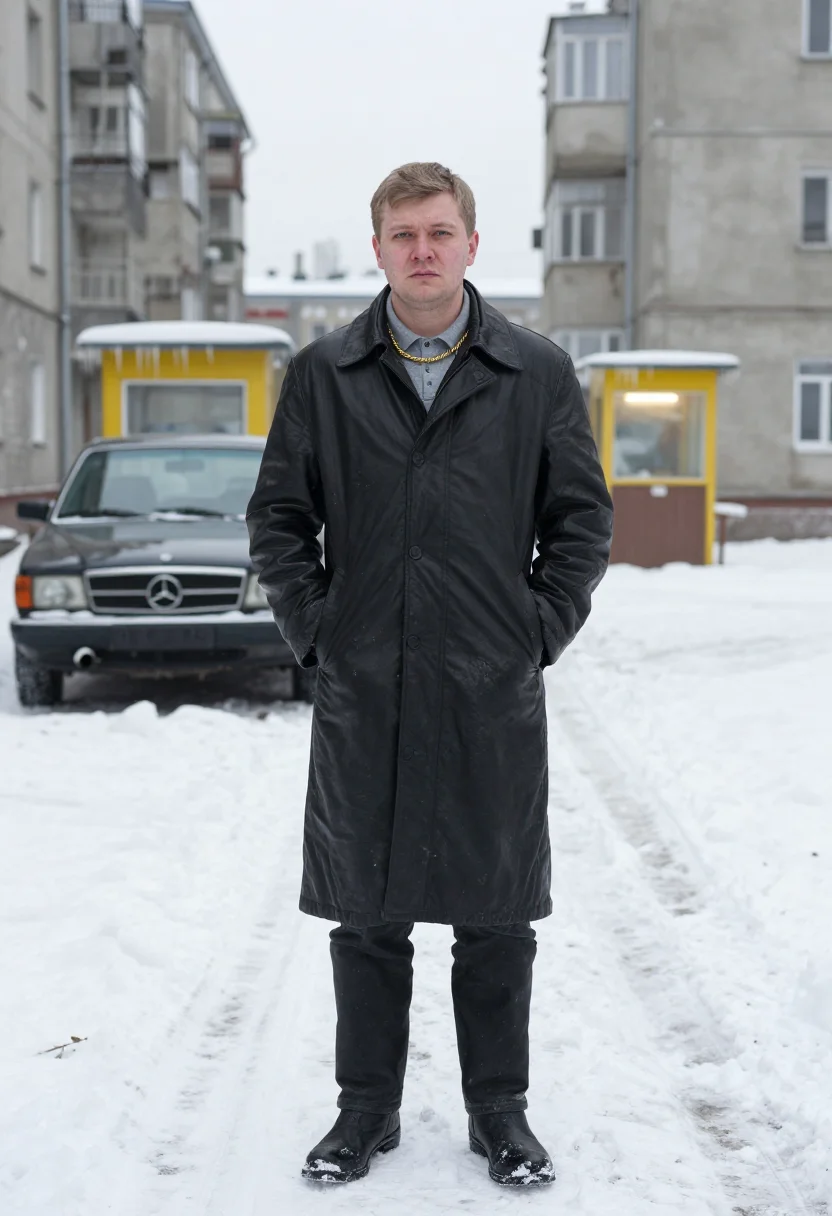
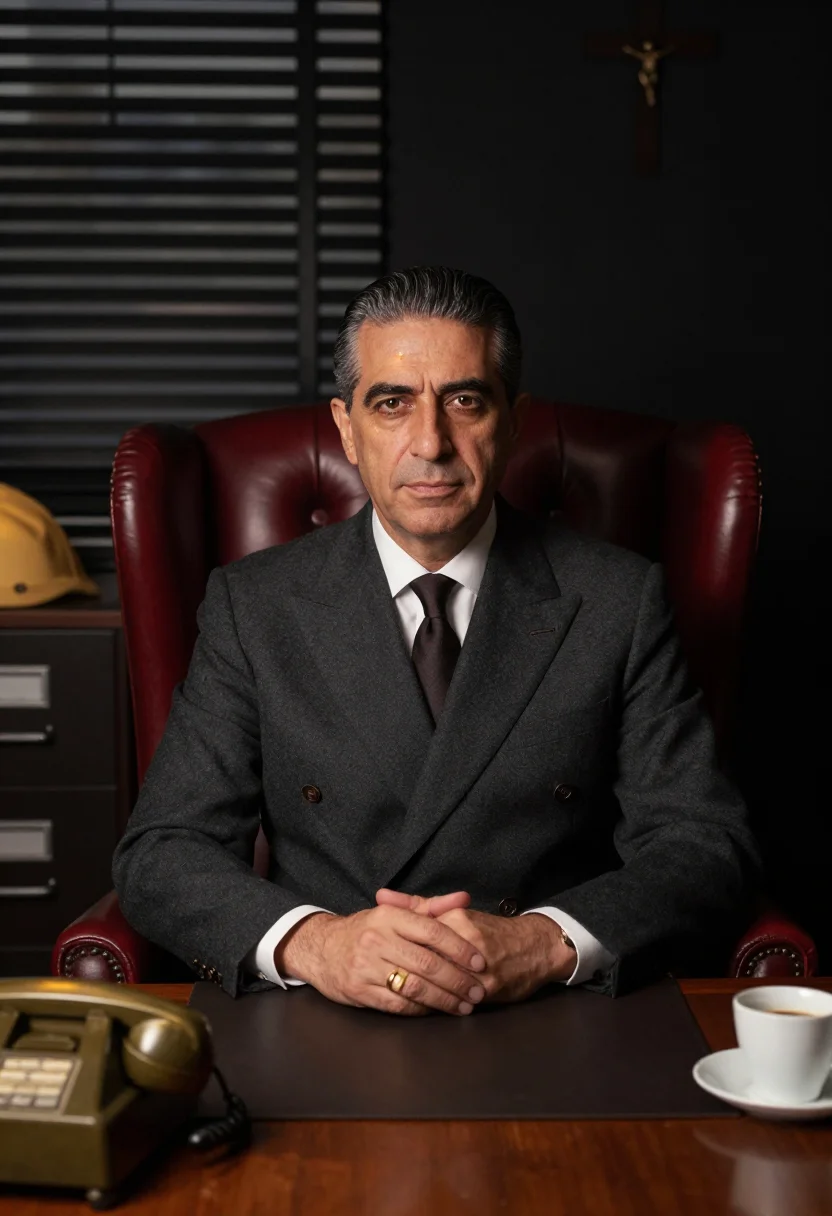
all 9 looks — from one photo ↓
How it works
Three steps. Upload, preview, deliver.
1
Upload 1 to 5 selfies
One is enough for the free preview. More angles sharpen the likeness.
2
See a free preview
A quick sketch of your likeness streams in seconds — close, not you yet, before you pay.
3
Train your model, then unlock 9
€4,99 one-time. Train your model once — 12 to 20 photos, we email you when it's ready — and all nine render in about ten seconds each. Every future pack and Studio portrait render the same way, no repeat training.
The vor v zakone register
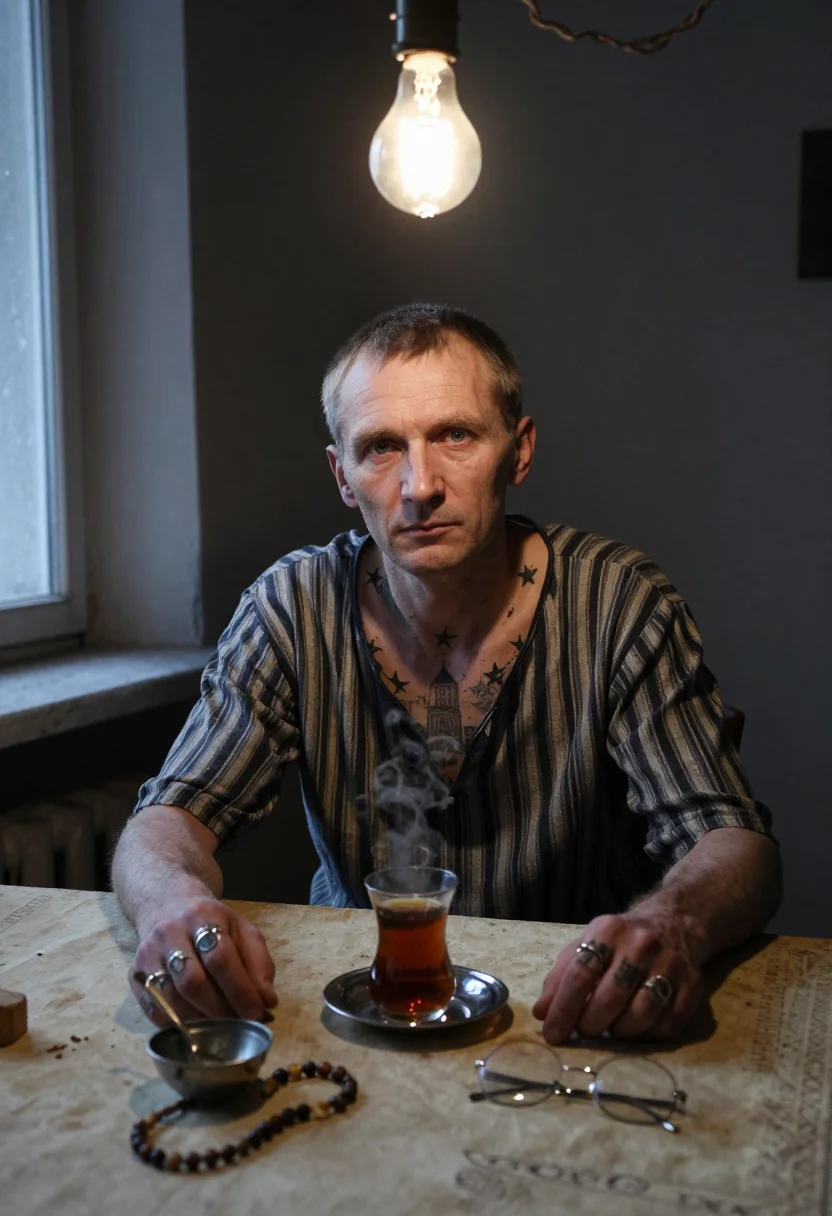
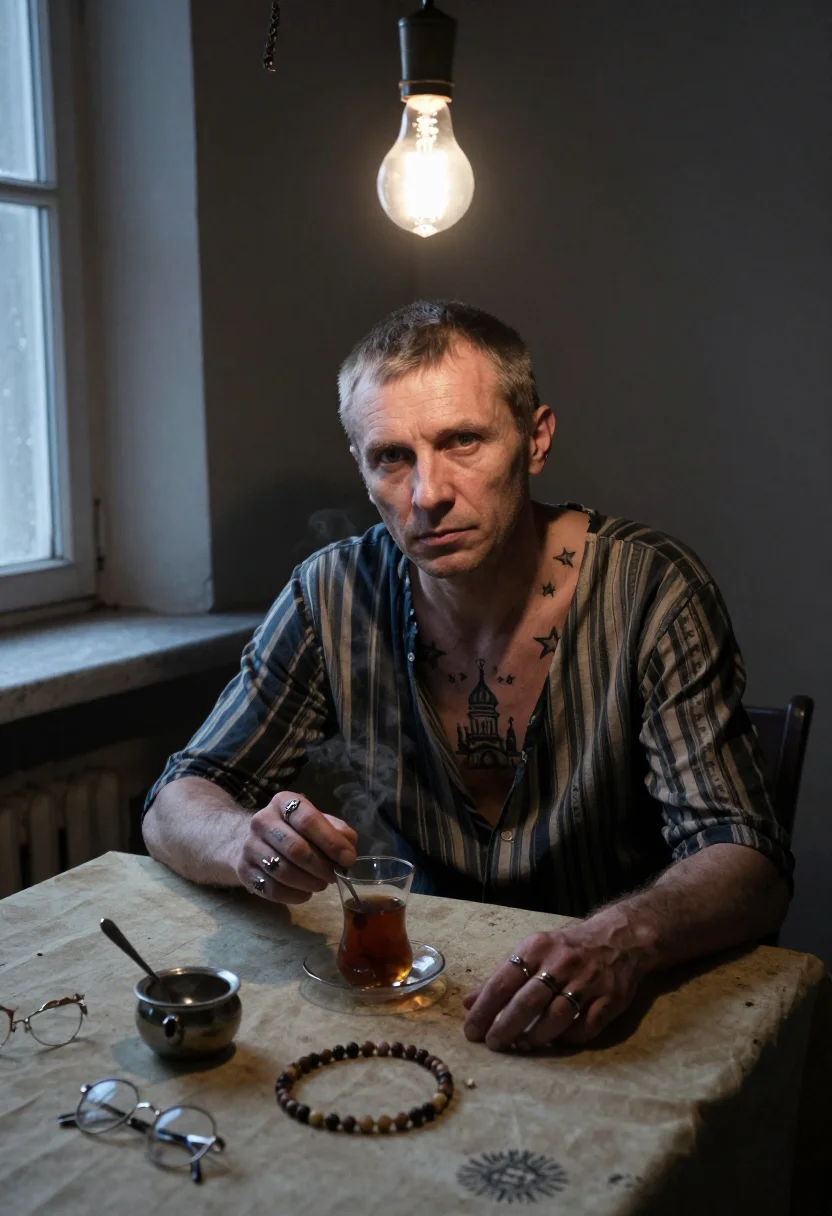
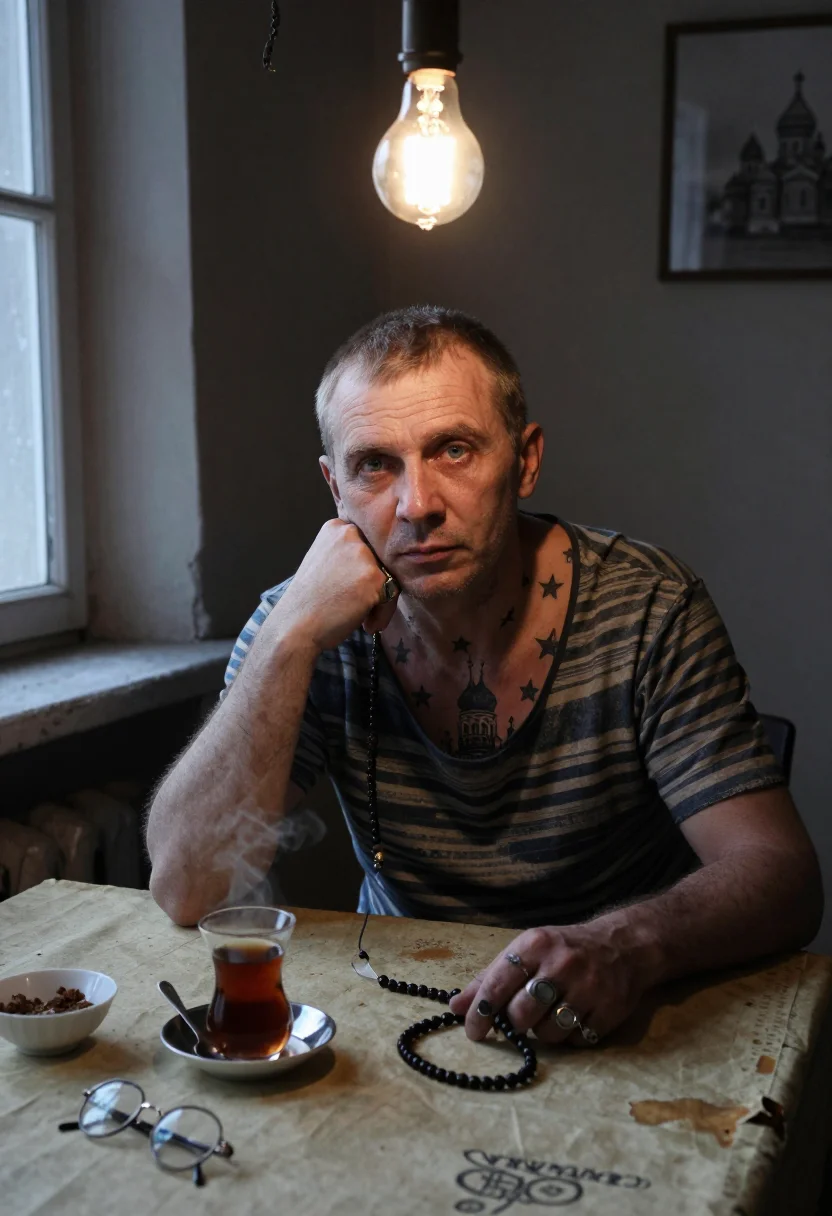
This is the coldest register in the house. It draws on late-Soviet documentary photography and on the Eastern European crime film — the room rather than the street, the table rather than the car. A vor's room in the 1980s: oilcloth on the table, a bare bulb on a twisted flex, an enamel samovar and tea in a podstakannik with a bent spoon, prayer beads twisted from bread, frost starring the window. Nothing in it is expensive. Everything in it is deliberate, and the code is written on the body: eight-pointed stars at the collarbones, a cupola church across the chest, rings inked on the fingers.
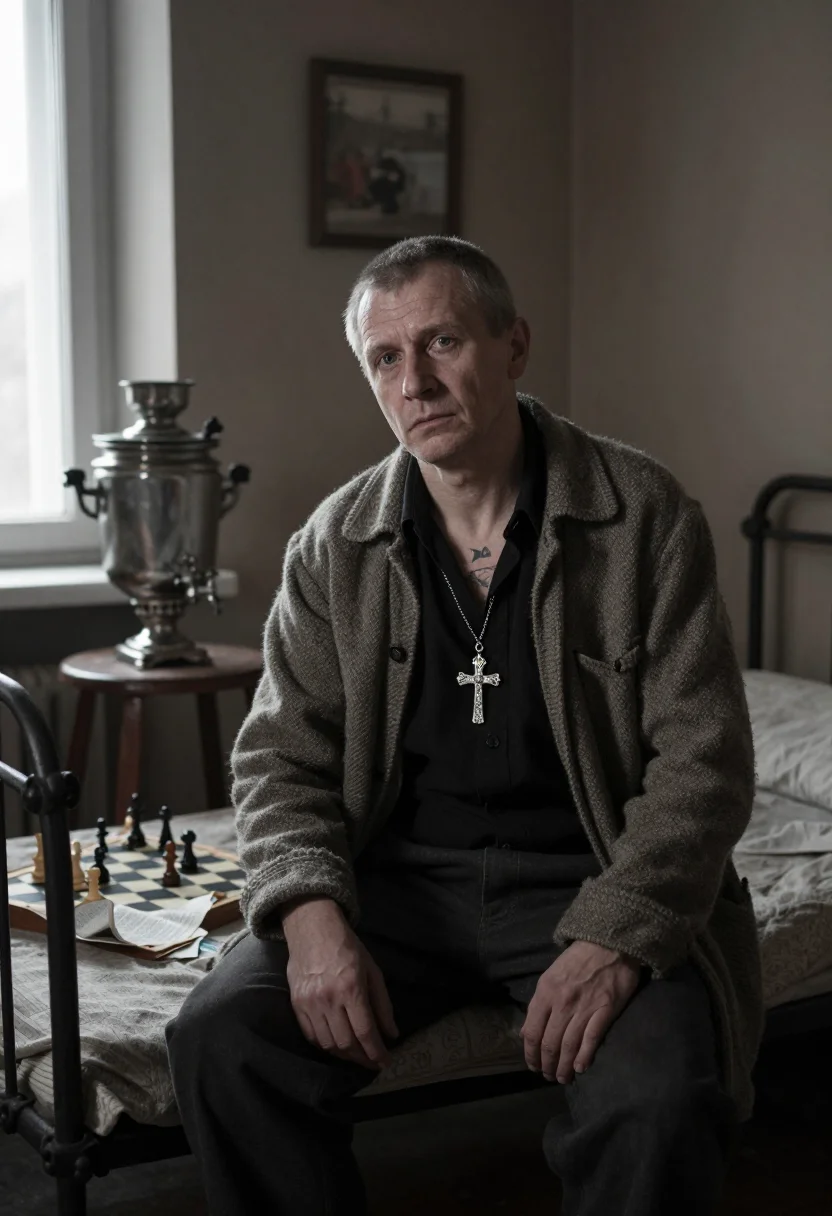
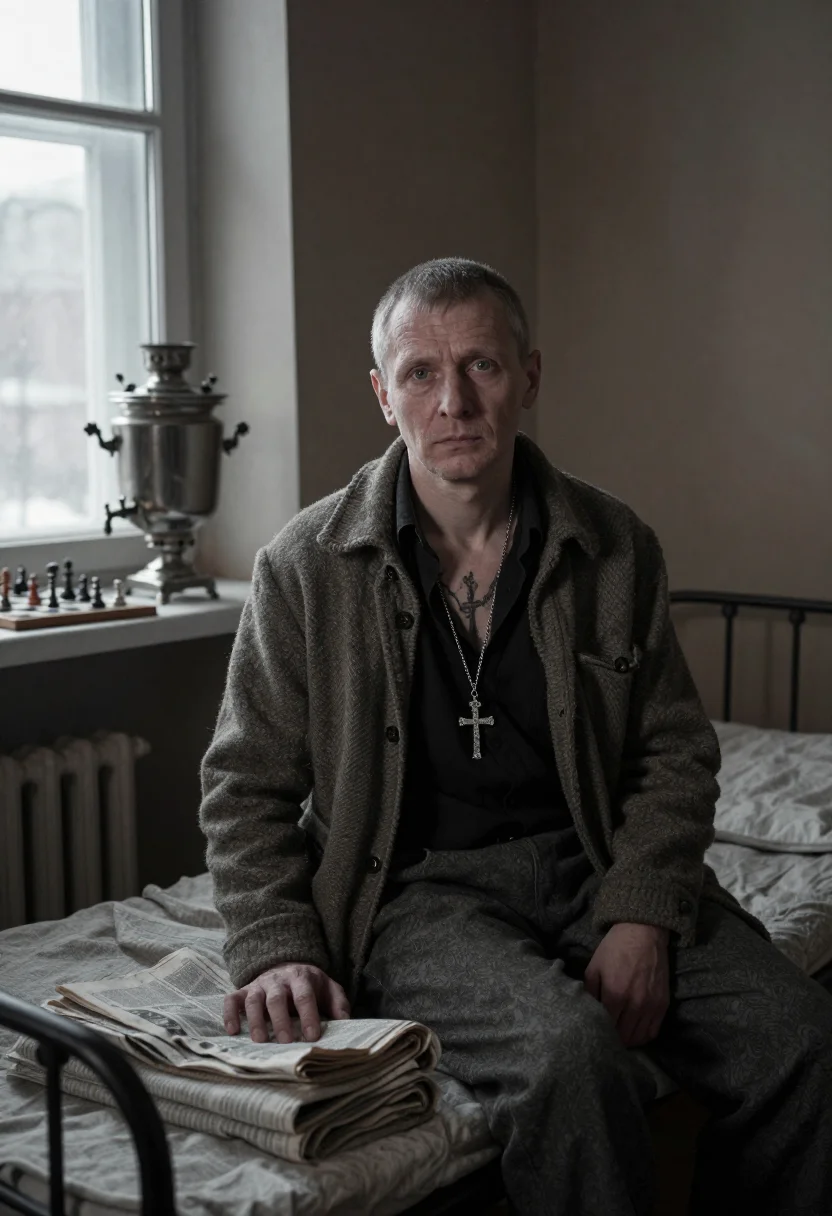
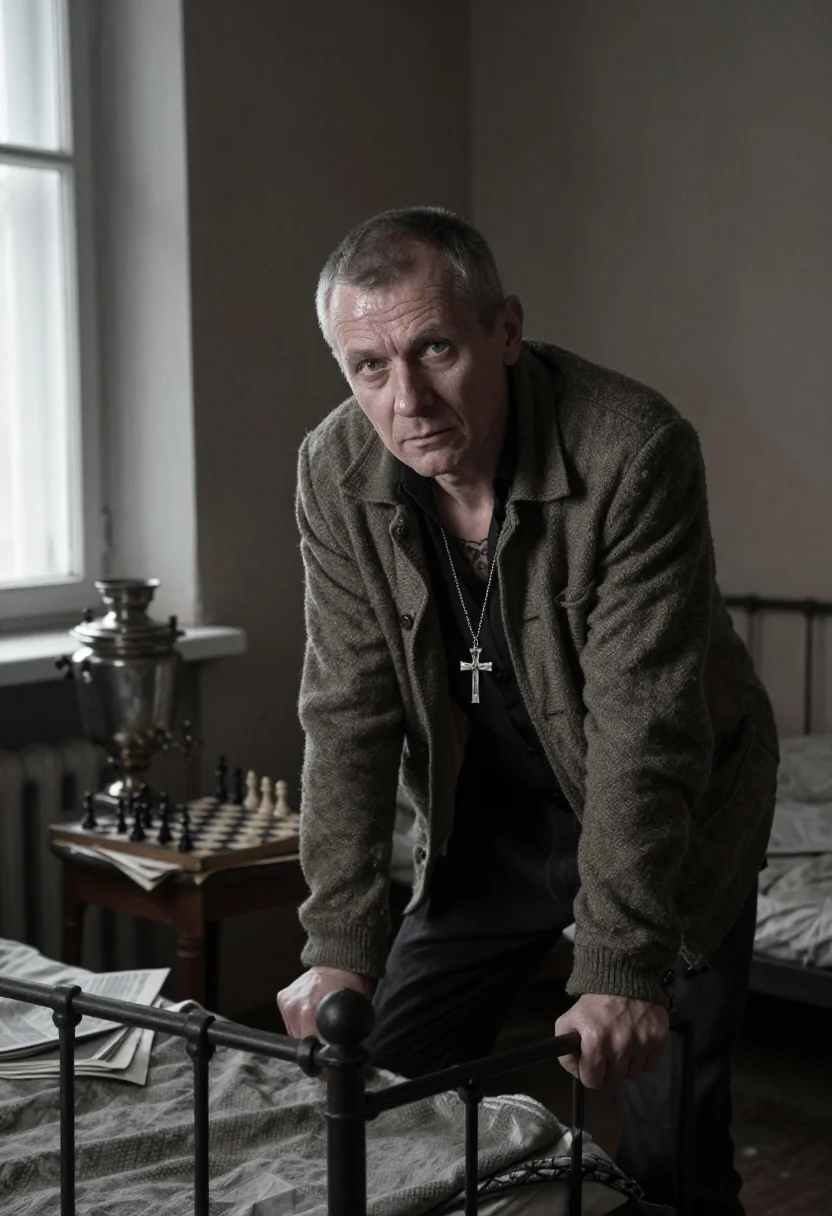
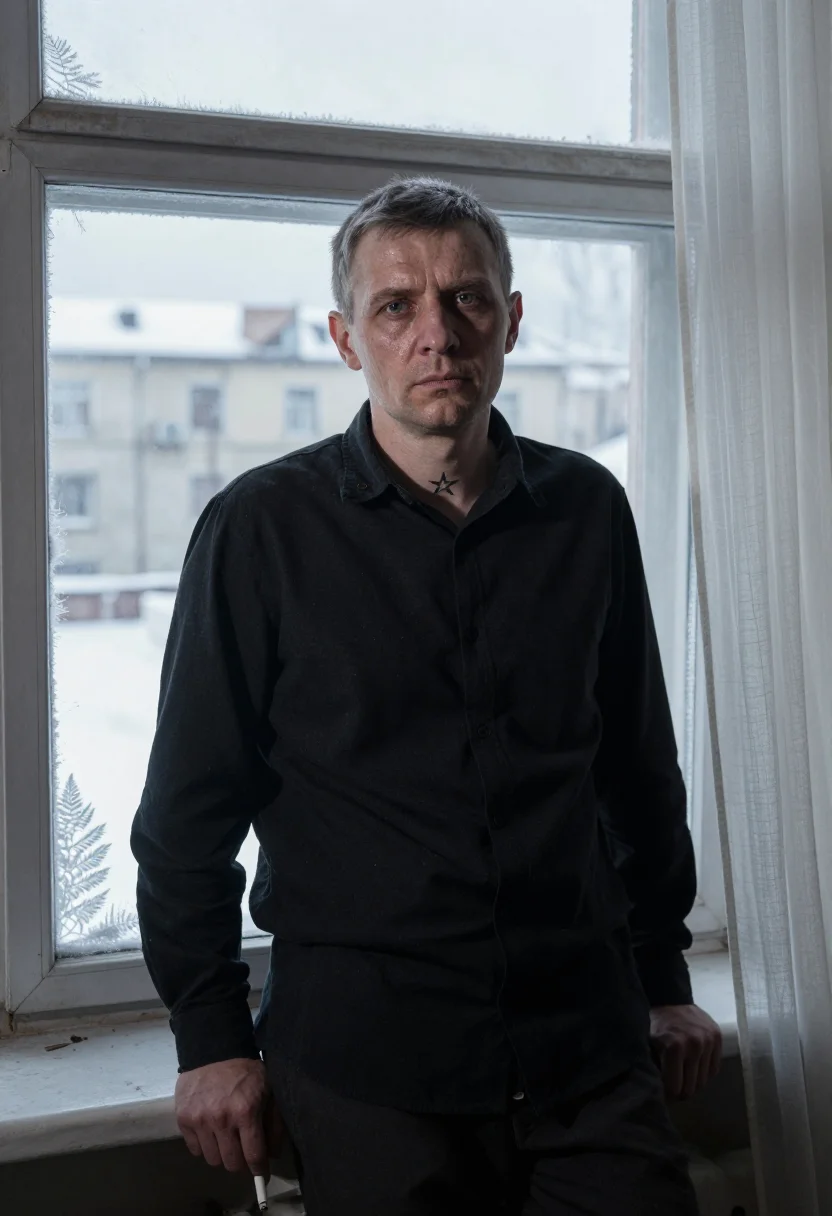
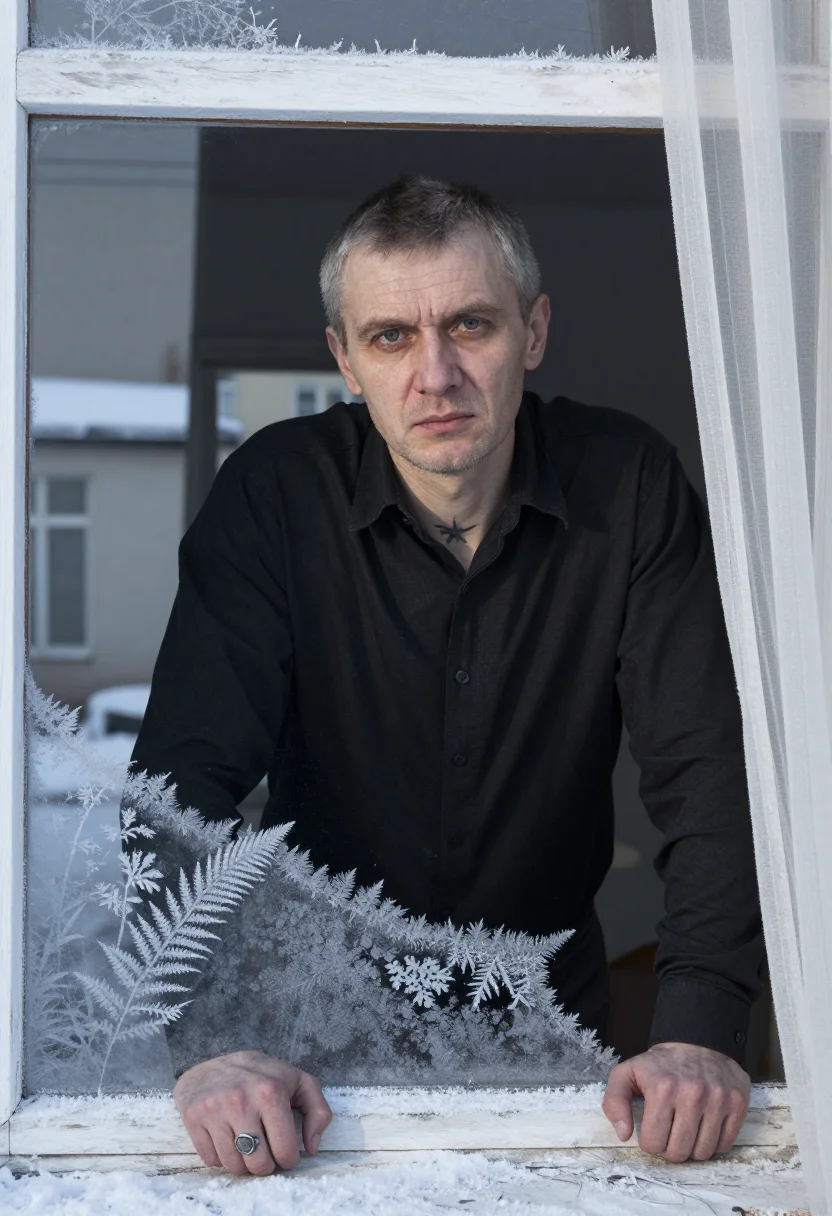
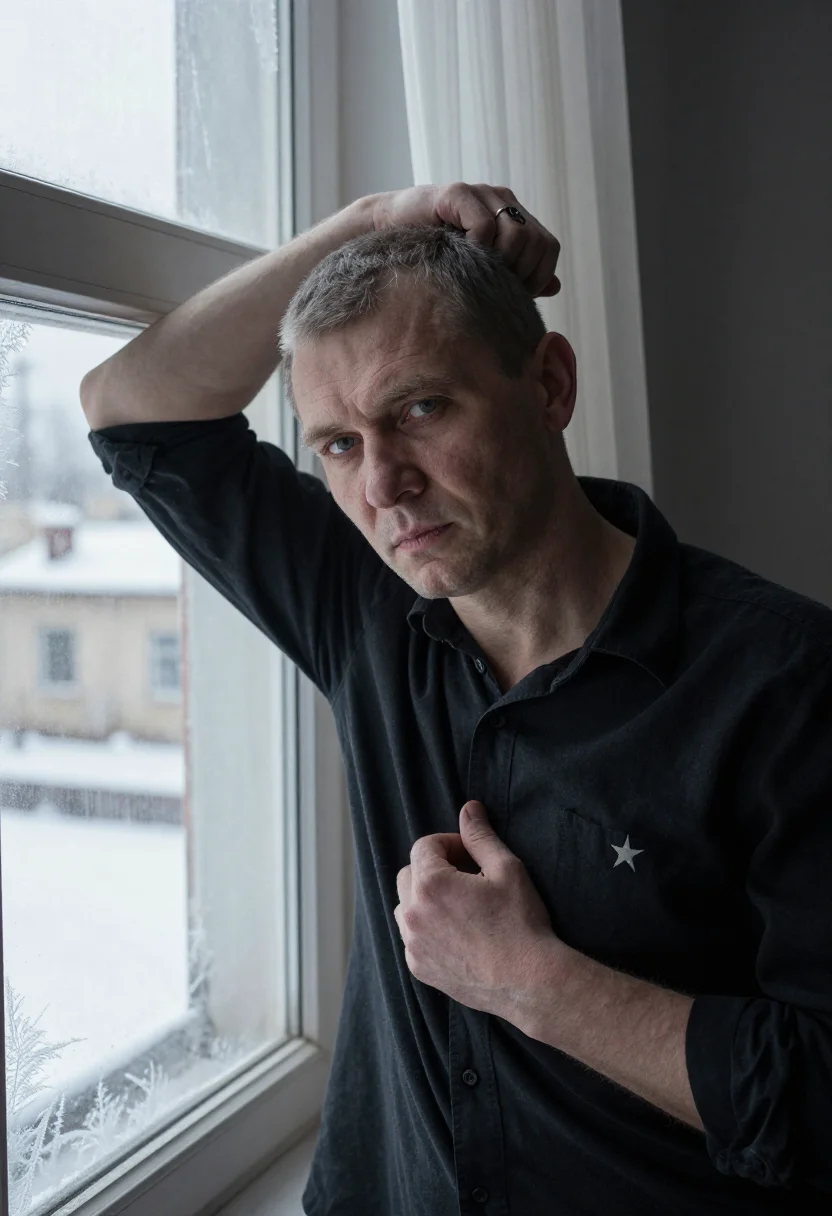
The three situations are all interiors, and all lit by whatever the room has. At the oilcloth table under the bare bulb, a striped telnyashka beneath an open black shirt, the chest ink readable in hard top light. In a dim room with papered walls and an iron bedstead, a woollen jacket over the open shirt, an orthodox crucifix on a chain against the ink, a samovar and a chess set in grey window light. And at a curtained window, the black shirt buttoned to the second button with one star showing at the collarbone, a heavy signet ring, a cigarette burned down to its last, cold daylight through frost.
Photographically that means hard overhead light with deep falloff, a desaturated palette of grey, ochre, black and the particular blue-black of old ink on pale skin, and framing that sits at chest height so the tattooing reads as part of the portrait rather than as decoration. No gloss, no rim light, no styling that looks recent. The reference is a photograph taken with available light in a room nobody was trying to make beautiful.
The output is photoreal. These are AI photographs of you in that room and that shirt, with the ink rendered on your own body — not a painting, not an illustration, and not a cosplay shot of someone else. The face across all nine frames is the face you upload.
How to photograph yourself for a soviet gangster photoshoot
Better source photos make better portraits. The pack works from an ordinary phone selfie — the free preview tells you in seconds — but a few things sharpen the likeness so the hard-light frames really read as you.
- Even, soft lightStand near a window with indirect daylight on your face. Overhead bulbs and phone flash flatten features, and that is the usual reason an AI portrait misses a likeness — the pack adds its own hard light later.
- Front or three-quarter angleCamera at eye level, facing it or turned slightly. No selfie-stick uplook, no shot from below.
- Face fully clearSunglasses off, hat off, hair off the forehead. A clear front-facing photo is the best photo for an AI portrait: more of your face means more of your likeness.
- A closed, unsmiling expressionThis register is still and watchful. A level gaze and a closed mouth carry it; a broad smile fights the whole world the pack is building.
- Plain background is fineYour own room does not matter — the pack replaces it entirely. A plain wall just helps the model concentrate on your face.
Frequently asked questions
- What do the nine photos actually look like?
- Nine photoreal portraits across three interiors: the oilcloth table under a bare bulb with a telnyashka under an open black shirt, a dim papered room with an iron bedstead and a samovar in grey window light, and a curtained window with frost on the glass and a cigarette burned to its last. Desaturated, hard-lit, unmistakably 1980s.
- Are these real prison tattoos, and does the pack depict a real person?
- No real person is depicted, and nothing here is a real record. The ink is a visual register drawn from Soviet-era criminal tattoo iconography as it survives in period photography and in crime cinema — stars at the collarbones, a cupola church, ringed fingers — rendered as costume. That vocabulary carried specific meanings inside a specific system; the pack borrows how it looked, not what it claimed, and endorses none of it. Every image is AI-generated from the face you upload.
- Does it look like me?
- It is built to. Whichever face you upload drives every render, so the nine come back as you in the shirt and the room, consistent across the set, rather than a stranger with your beard.
- Can women use this pack?
- The sample and styling are built for men — the telnyashka, the chest ink, the woollen jacket — so it reads masculine throughout. A women's or mixed version of this pack is not shipped yet.
- How is this different from Midjourney or Lensa?
- Text-to-image tools will render a convincing tattooed man who is not you. Avatar apps hand back stylised images that read plainly synthetic. This pack anchors every frame to your uploaded face and keeps the output photographic, so all nine are the same person, and that person is you.
- Will the tattoos look real, or drawn on?
- They are rendered as skin, not as stickers — old blue-black ink sits differently from fresh work, and that is what the hard bulb light is there to show. It is the most technically demanding part of the pack and the reason the framing stays at chest height.
- What if my selfie is bad — poor light, phone camera, old photo?
- One clear selfie is enough to start, and the free preview shows the likeness in seconds. If it comes back soft, the prep tips above are the fastest fix, and it is nearly always lighting rather than the camera.
- Can I use it as a profile picture or a band photo?
- Yes to both. It makes an unusually strong profile picture, and the register suits a band photo, an album cover or an author image where the default headshot reads too clean.
- Can I use it on a dating app?
- You can, but be honest about it — it is a styled costume portrait, not a photograph of your life. Some people love it as an opener; others will read the ink literally, which is worth knowing before you post it.
- Can I use it as a character reference for writing or a film project?
- That is a fair use of it. Writers and art departments use packs like this as a look reference for a period character — the pack is a visual register, so treat it as reference rather than research.
- What happens to the photo I upload?
- Your preview photo is processed on European servers. If you train your model, those photos train only your model and are deleted the moment you delete it. Nothing is sold or shared with third parties.
When the vor v zakone pack fits
- For a profile picture that stops the scroll instead of blending into it
- For a social post in a period crime register rather than a filter
- For a band photo, album cover or press image with weight to it
- For an author photo when the genre is crime, cold war or noir
- For a themed party or Halloween costume you want to visualise first
- For anyone who has always wanted the hard-light, high-contrast portrait
- For a gift for someone who watches Eastern European crime cinema
- For a phone or desktop wallpaper with grain and no gloss in it
- For a print or framed portrait that looks like a found photograph
- For a character look reference for a writer, illustrator or art department
- For a mood board on 1980s Soviet interiors and available-light portraiture
About narcis
Most AI portrait tools ship every pose, profession, era, and aesthetic in one giant catalog. The output looks like every other AI photo on the internet — a glaze over a stock face. Narcis goes the other way. One tool, one job: turn photos of you into portraits worth keeping. Drop a selfie and your free preview streams in seconds — a quick sketch: close, not you yet. For portraits that are truly you, train your own model on 12 to 20 photos; it trains in the background, and we email you when it is ready. Train once, render everywhere — this pack, every other pack, and the Studio all come out of that one model, about ten seconds a portrait, and it stays yours to retrain or delete. Each pack is hand-curated against actual references — paintings, photographers, registers — and tested on real faces before it ships. See a free preview before you pay, not after. Packs are one-time — no subscription to buy one; Studio, the unlimited composer, is optional at €12/month and every pack includes 30 days of it. No template generator. Built and run by one team, on our own infrastructure.
All images are AI-generated. By using this service, you confirm you are 18+, that any face photo you upload is your own or used with explicit consent. Full Terms